

My Bowie
How David Bowie still illuminates my life ten years on from his death

David Bowie is poor first-date material. Across a table of pork and chive dumplings and shallot pancakes, my now-partner and I were getting to know each other. Reaching for my beer, I took a swig to cool myself in the unairconditioned, open-front restaurant on King Street. I wasn’t used to these kinds of nerves, but conversation flowed joyously and easily. It was all going so swimmingly.
And then, as it often does with me, the conversation turned to music. I listened to her opinions. I asked probing questions. We talked about what we loved and what we didn’t love. Then something shifted.
In a turn of phrase, with the slightest twist of a word, my partner said, ‘I don’t understand people who are obsessed with David Bowie.’
Like a forest fire, I ignited without rhyme or reason, surging forth without noticing how I was so swiftly destroying everything I had built.
I explained how Bowie’s complicated chameleon mechanisms allowed him to blend in with the times, both assimilating style while pushing it forward in his own unique way. I described the power of the Berlin Trilogy and the importance of its creation. I expounded my adoration for Station to Station as not just Bowie’s greatest, but one of the most intriguing, disturbing, and extraordinary inhabitings of a character, taking pop music further than anything prior – or maybe since. I, to put it plainly, spent forty-five minutes lecturing her about David fucking Bowie.
She almost never went on another date with me again.
Berlin in winter bites down on you. Grey facades leach ice into the air. The ground beneath you slides in great flat stretches between dead trees and brutalist structures – a city stuck between a complicated past and present. Curled up in a grey coat and beanie, I understood why artists came here to escape and create. There was little else to do.
Walking grim streets, the breath of every passing figure told me they were not ghosts. The artistic qualities of Berlin enticed my family. They felt right at home, while I became remote, silent, difficult (not unusual for me).
Through frost-stiffened hands, I reached down and tried feebly to unravel my headphones. Managing to squeeze them into my ears, I pressed play on David Bowie’s Low.
Screeching to me across my mind, the sound of a passing siren gave way to the propulsive bend of Carlos Alomar’s humming guitar and Dennis Davis’ quicksand drums. George Murray’s bass crackled and crinkled like flesh beneath it all, and the grim city I traversed began to have life fed back into it.
I caught the train from Potsdamer Platz with only one location in mind. Stepping out onto the platform, the piano trill and explosive horror-movie momentum of ‘Be My Wife’ barrelled in with all its gloom:
Sometimes I get so lonely.
I walked the long street, looking miserable.
I’ve lived every place.
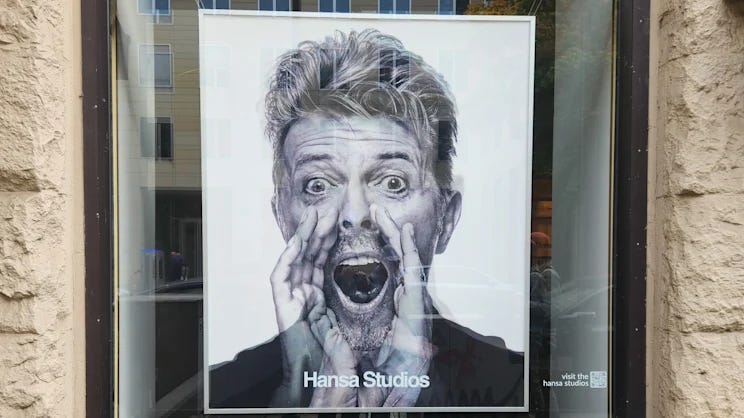
The cold bit hard. I just about cocked my head up, seeing these strange parliament-like buildings. Confused if I had come to the right place, I walked a little further and met Bowie face to face. He stared at me from behind glass. His head was in silhouette, looking out onto the street, shouting through cupped hands as if to warn me with those alien eyes.
Hansa Studio rose high above me. ‘Warszawa,’ in all its funeral dirge, filled my body like hot water. Life collapsed and rose once again in new forms. Bowie gazed at me with awareness. I didn’t understand the city I had found myself in. It made me cold, and I felt a little sick. But just as he has always done, Bowie’s music connected my life like a long string, helping me draw a little bit of sense from my experiences in ways that I didn’t know were possible.
Heathrow is longhand for hell. I recoiled in my uncomfortable chair, surrounded by thousands of travellers, trying to escape the slamming bodies. Flicking through my phone, I received a notification saying David Bowie’s new album was now available for me to listen to.
I pressed play and opened Pitchfork to read their effusive review. Unearthly music took the space of everything else around me. The review ended:
‘This tortured immortality is no gimmick: Bowie will live on long after the man has died. For now, though, he’s making the most of his latest reawakening, adding to the myth while the myth is his to hold.’
Laying back, I closed my eyes. I didn’t quite understand what I was listening to. The drums scuttled rather than crashed. Saxophones punctuated the bass-laden space. The vocals were airless, holding back the fire I expected from Bowie on albums like Let’s Dance and Station to Station. On top of that, the lyrics were stressing me out. It was as though Bowie was Dante narrating his descent into the inferno.
Opening my eyes, I looked around just as Bowie sang, ‘Look up here, I’m in heaven.’ It didn’t feel like it. Heathrow pounded away while people looked miserable, all soundtracked by Bowie’s dark cosmos. I felt ill at ease. I had to press pause and go get myself a Lucozade – or a lobotomy.
On the plane, I tried to listen to the album again. This time, the music let me rise with the airless lift of the plane as it began to level in the night sky. ‘Sue (Or in a Season of Crime)’ broke through like a bomb. The drums stamped into battle in a masterclass of rhythm that feels both punk and avant-garde. ‘Girl Loves Me’ only enhanced this warped experimentation, with that screeching terror in Bowie’s voice as he shouts, ‘Where the fuck did Monday go?’ This is more like it, I thought to myself, closing my eyes, praying for a gin and tonic. I fell asleep quickly in weightless rhythms.
When we arrived back in Sydney, I was dazed. I didn’t know what was up or down. My phone was readjusting and couldn’t find internet. Being eighteen, it felt like the end of the world. Eventually my phone figured itself out, and I decided to go visit a friend for the night to play music and darts.
While lying on his couch, trying not to fall asleep, I checked my phone as it started to blow up. ‘David Bowie is dead.’ I sat up, wondering if I was reading it wrong. Wasn’t I just with him? Wasn’t he alive when I listened to him tell me, ‘I can’t give everything – awayyy’? I told my friend the news. He appeared shocked but not saddened. I stared at my phone, watching my hand shake. I looked up other news websites just to make sure. He’s gone, they told me. I felt myself begin to cry, and I’m not sure why.
A week later, I found myself at a Courtney Barnett concert by chance. The Enmore Theatre was energised and lively. Wearing a Bowie shirt and leaning deep into the crowd, everyone reached their hands up in praise and thanks – whether to Barnett or Bowie, I don’t know. As the encore came to a close, the lights stayed low as if to suggest a second. Through the speakers, the bouncing drums and harmony of Bowie’s ‘Let’s Dance’ lifted higher and higher, and everyone was bouncing on their feet. For six minutes, the entire crowd stayed to dance.
Everyone was giddy, smiling with the joy of the greatest sort. Joy and sadness. Almost everybody was crying. In the most brilliant of songs, we were overwhelmed by the genius of one man and his ability to bring everybody together in a moment of euphoria – a universal language unlike any other. I put my arms around a stranger. My brother and mother danced together, swinging each other through the warm air. Everyone stayed in tribute and gratitude as we danced into the night.

Many years pass, and Bowie still changes us.
Thanks to Bowie (and, of course, myself), I learned how close I came to not having the many joyous years my partner and I have had together. I spent many of those years trying to convince her that my original berating had not gone to waste, but what I didn’t understand was that the Bowie I fell in love with might not be the Bowie she would fall in love with.
One day, driving along the M4, I suggested we put on Blackstar. It had been a few years since I’d listened last, and I was curious to see if my partner would find it as strange as I first had. She had tried so hard to enjoy the Bowie albums I loved—always open to new (and sometimes unlistenable) music suggestions. However, I made the mistake of constantly showing her the albums I loved over and over again.
We put on Blackstar and went from there. After the album came to a close, she looked at me and said, ‘Why didn’t you start with this?’ This set in motion many years of discovering Bowie together—many albums I had never bothered to listen to but have since become favourites—including the discovery of what is now our joint favourite song: the pummelling ‘Seven Years in Tibet’.
Everyone has their own Bowie – the one they see themselves in, where the character and the music speak directly to that individual. No musician or artist has managed to envelop so much of life’s strange and extraordinary experiences into a career that speaks so many languages. As a child, I remember listening to a Bowie Best Of, confused by the different people singing on each song. When I asked why the frontman kept changing from song to song, my dad smiled and said, ‘That’s why they call him the chameleon. Because he never stayed the same.’
In all his forms, he slid into different characters, filling their worlds with melodies so perfect that it is impossible to pick just one all‑encompassing Bowie track. They’re all different and masterful in their own way. Genius is bestowed on too many imitators and posers, but there is only one true pop musical genius – and Bowie is all of them.
Even today, I think about Bowie most days. He is my Roman Empire. There are memes that suggest Bowie’s death was the point where everything started to go terribly wrong with the world. People talk about his music – even his failed experiments in the late eighties – as if they were groundbreaking frontrunners to every new sound that came after. There are countless videos of famous people talking about how meeting Bowie was probably the most important moment in their lives. He has become a deity of sorts – the greatest of us, and also so unlike us.
But what we often forget is that he was also human. It is that purely human instinct to understand and connect in any possible way that allows his music to speak to everyone differently. Where my gateway was those first chugs of the train before the tolling of the bass on Station to Station, my partner’s was Blackstar’s jazz‑infused experiments. I know so many people who would choose Hunky Dory’s freakish ability to make a melody go supernova, or pick the chug and roar of Ziggy Stardust. But it’s all personal – which is what makes him universal.
The Bowie song I return to – day after day, year after year – is the penultimate track on Blackstar, ‘Dollar Days’. It begins with alternating chords that loosen into a descending shuffle of melancholic piano, guitar, bass, drums, and free‑wheeling saxophone. In his vocals, Bowie reminisces on an entire life with a strange despondence. He sings as if crying:
If I'll never see the English evergreens, I’m running to
It’s nothing to me
It’s nothing to see
In that simple callback to his childhood home, picturing the rising memories of his past as he runs towards his death, we see a man still ‘dying to push their backs against the grain and fool them all again and again’. He tried so hard to play a character—to fool his listeners from looking too deep into the heart of a man—that by the end, he couldn’t help but open himself up completely. Bowie’s greatest final act was to play himself, which made him all the more unbelievable.
I wanted to contain the man in this piece. I wanted to explain him completely in writing. But I know that is an impossible task, because the Bowie I know and love is different from the one you love (or don’t, but should). All I can do is express my gratitude for all the music that still plays, floating by us on the street, in our headphones, in our minds and clubs and concerts. Listening today, ten years after he left us for his next great act, I can’t help but remember all those personal moments of gratitude I have – not just for the music, but for the man. And so I cry.
I cry because I don’t understand. I cry because I know others love him like I do, and probably more, and definitely differently. I cry because I still hear him every time I listen to his music. I cry because he’s not here. And finally, I cry because he is always here, talking to us from beyond, revealing we are all connected even when we think we are not.